What begins as an ordinary journey to the city soon turns into an unexpected intrusion into the carefully guarded life of a young couple. Inna Azumi is determined to leave the village behind, carrying an enormous bag, a heart full of excitement, and one very specific mission: to perform the traditional post childbirth zaman wanka for her granddaughter. But she has not told everyone the truth about her journey, and she certainly has not prepared herself for what awaits her when she finally reaches the city.
Her excitement over city food, the chance to stay with her grandchildren, and the satisfaction of making her rival Tasalla jealous may be the least of her problems. Because the house she expects to enter is locked, the family she expects to meet is nowhere to be found, and a young husband named Imran is about to discover a mysterious oversized bag waiting outside his home.
Who is behind the bag? Why has Inna Azumi arrived without proper notice? And how will her traditional idea of kwana arba'in fit into the private life of a young couple whose marriage already has its own expectations and boundaries?
Summary
Inna Azumi is preparing for a journey that means far more to her than a simple visit to the city. She fills a huge bag with clothes, bedding, personal belongings, and enough supplies to make anyone wonder whether she is visiting or relocating permanently. Her excitement is obvious, especially because she believes she is finally going to enjoy the comforts and delicacies of the city while carrying out her duty as a grandmother. Even the old perfume she has been saving for a special occasion makes its way into her luggage.
Before leaving, however, she has to obtain permission from Malam, her husband. What should have been a straightforward conversation quickly becomes a humorous confrontation. Malam is suspicious of her sudden preparations because Inna Azumi has not previously told him about any journey. Tasalla, her co-wife, is also present, and the situation becomes even more complicated when the two women's long-standing rivalry begins to surface. Tasalla cannot hide her irritation at the thought of Azumi going to the city while she remains behind.
Azumi eventually explains that Sa'adiyya, the granddaughter she intends to visit, is in labor and that she has been called to perform the traditional post childbirth bathing period known as zaman wanka. When Malam questions how she could possibly know the exact timing of the birth, Azumi's explanation creates even more confusion. Rather than backing down, she resorts to emotional persuasion, reminding him of the relationship she had with her late son and the importance of being there for her granddaughter. Her performance eventually works, and Malam gives her permission to travel, along with some money for the journey.
The excitement only grows once Azumi reaches the city. Her phone has died, communication with the family becomes difficult, and she begins navigating from one location to another in search of the house. But when she finally reaches the address she expects to find, the house is locked. The situation becomes increasingly strange when another house she identifies is also closed. Instead of turning back, Azumi decides to wait with a neighbor after learning that Sa'adiyya is still at the hospital. Her determination to fulfill her role as a grandmother remains stronger than the inconvenience surrounding her arrival.
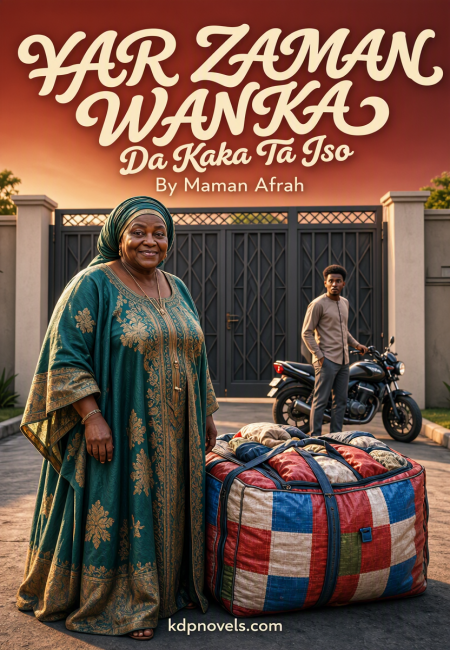
Meanwhile, Imran is on his way home. Unlike Azumi, he is a young man who prefers privacy, cleanliness, and the company of his wife, Sa'adiyya. Their marriage is built on love, and Imran is deeply attached to her. He dislikes unnecessary visitors and avoids social gatherings whenever possible, preferring to spend his time at home with his wife. But as he approaches his house, something immediately catches his attention: a huge, dusty travel bag sitting outside his locked home. Imran has no idea who brought it there or why it is waiting at his doorstep. Then, just as his curiosity begins to rise, he hears a voice.
And that is where the real trouble may begin.
Novel Description
Ƴar Zaman Wanka (Kwana Arba'in) is a Hausa domestic drama infused with comedy, family tension, cultural traditions, marriage dynamics, rivalry, and suspense. The story takes readers between the quieter environment of the village and the busier atmosphere of the city, using the contrast between the two settings to create much of its humor and conflict.
At the center of the story is a traditional family practice surrounding childbirth. Inna Azumi's determination to travel for her granddaughter's zaman wanka gives the narrative its initial direction, but the journey quickly becomes more complicated than she expects. Her personality, her relationship with her co-wife, and her tendency to use dramatic persuasion make even simple situations entertaining.
The city setting introduces another dimension to the story. Azumi arrives expecting warmth, family, food, and an opportunity to perform her grandmotherly duty. Instead, she encounters locked doors, uncertainty, and an increasingly confusing situation. The arrival of Imran adds another layer of suspense because he has no reason to expect a visitor, especially one accompanied by such a conspicuous bag.
The story's strength lies in the way ordinary family situations are transformed into moments of comedy and tension. Conversations between characters reveal their personalities naturally, while the unresolved questions surrounding Azumi's arrival create anticipation for what will happen when the older generation meets the younger couple.
Core Themes
Tradition and Family Responsibility
The concept of zaman wanka places traditional family responsibilities at the heart of the story. Azumi sees her granddaughter's childbirth as an occasion that requires her presence, regardless of the distance or inconvenience involved. Her determination reflects the importance placed on extended family participation during major life events.
Marriage and Co-Wife Rivalry
The relationship between Azumi and Tasalla introduces another important dimension. Although the women are older, their rivalry has not disappeared. A simple journey to the city becomes an opportunity for teasing, jealousy, competition, and emotional provocation.
Love and Privacy in Marriage
Imran and Sa'adiyya represent a younger marriage built around affection and emotional attachment. Imran's strong preference for staying close to his wife also establishes how protective he is of the private world they have created together.
Generational Differences
The story places traditional expectations alongside the lifestyle of a younger urban couple. Azumi arrives with her own understanding of family duties, while Imran's personality suggests a very different attitude toward privacy, personal space, and household life.
Comedy in Everyday Life
Much of the humor comes not from extraordinary events but from the characters themselves. Azumi's dramatic personality, her exchanges with Malam and Tasalla, her enormous luggage, and her determination to reach the family all contribute to the story's lively atmosphere.
Unexpected Consequences
Azumi believes she knows exactly what she is going to do when she leaves the village. Yet almost immediately, circumstances begin to move outside her control. The locked houses, missing family members, dead phone, and mysterious bag all suggest that her carefully planned visit may become something entirely different.
Key Characters
Inna Azumi
Inna Azumi is the driving force behind the opening events. She is outspoken, dramatic, humorous, determined, and highly aware of family relationships. She enjoys teasing Tasalla and is not above using emotional arguments when she wants something from Malam. Beneath her playful behavior, however, is a woman who genuinely cares about her granddaughter and feels responsible for being present during an important family moment.
Malam
Malam is Azumi's husband and the man whose permission she seeks before travelling. He is initially suspicious because of the secrecy surrounding her preparations. His conversations with Azumi reveal patience mixed with firmness, while his reactions to her dramatic explanations provide some of the story's funniest moments.
Tasalla
Tasalla is Azumi's co-wife and one of the sources of tension in the household. She is clearly displeased by Azumi's opportunity to travel to the city, particularly because she imagines Azumi enjoying city food while she remains behind. Her silent reactions and subtle taunts show that the rivalry between the two women remains very much alive.
Imran
Imran is a young married man whose personality contrasts sharply with Azumi's. He is private, extremely particular about cleanliness, and strongly attached to his wife. He prefers staying at home rather than mixing with people unnecessarily. His peaceful routine, however, is about to encounter an unexpected disturbance when he discovers the enormous bag outside his house.
Sa'adiyya
Sa'adiyya is Imran's beloved wife and the granddaughter whose childbirth brings Azumi to the city. Although she has not yet appeared directly in the presented portion of the story, her situation is responsible for Azumi's entire journey and becomes an important connection between the older and younger generations.
Analytics and Insight
The opening of Ƴar Zaman Wanka (Kwana Arba'in) uses humor as a gateway into a deeper family story. Inna Azumi is not simply travelling to the city. Her journey brings together different generations, different expectations about marriage and family, and different ideas about privacy and tradition.
One particularly effective element is the contrast between what Azumi thinks will happen and what actually happens. She leaves the village with confidence, convinced that she is heading toward a comfortable stay filled with family, food, and celebration. Instead, she encounters one complication after another. This creates a natural suspense structure because readers already know that her arrival is unlikely to be as simple as she imagines.
The oversized bag also works almost like a symbol of her personality. Azumi is not travelling lightly. She carries clothing, bedding, personal belongings, and expectations with her. When that enormous bag eventually appears outside Imran's home, it immediately becomes a source of curiosity and signals that Azumi's arrival is going to affect the household in some way.
The story also uses dialogue heavily, allowing character personalities to emerge through their own words. Azumi's dramatic speeches, Malam's questioning, Tasalla's reactions, and Imran's reserved nature make the characters feel distinct rather than interchangeable.
Most importantly, the opening leaves a deliberate question hanging in the air: what happens when a determined grandmother carrying traditional expectations enters the private world of a young married couple who were not expecting her?
That question gives the story its forward momentum.
An Insightful Quote
“Sometimes a journey begins with excitement, only for the first locked door to reveal that the real story has not even started.”
Why Readers May Want to Start Reading
Ƴar Zaman Wanka (Kwana Arba'in) combines the warmth of extended family relationships with the humor of everyday domestic life. It does not rely on one dramatic event alone. Instead, the tension grows through conversations, misunderstandings, rivalry, cultural expectations, and the unpredictable behavior of its characters.
Inna Azumi's journey is particularly intriguing because she believes she is going to the city to perform a familiar family duty. Yet by the time she arrives, nothing seems to be going according to plan. Her unexpected presence, the locked house, her enormous luggage, and Imran's discovery of the mysterious bag create a perfect setup for further complications.
The story promises laughter, family drama, cultural detail, marital tension, and the kind of unexpected encounters that can turn an ordinary visit into an unforgettable experience. For readers who enjoy Hausa stories built around strong personalities, traditional family life, humorous dialogue, and suspenseful domestic situations, Ƴar Zaman Wanka (Kwana Arba'in) offers a compelling reason to turn the next page.







![<? $row['name']; ?>](https://kdpnovels.com/Public/thumb/225x325/ebook/2026/04/kdp-velvet-76-rayuwa-da-gi-i-0187303be8.webp)
![<? $row['name']; ?>](https://kdpnovels.com/Public/thumb/225x325/ebook/2026/04/kdp-velvet-78-karuwan-cikin-gida-book-2-4162a6ec19.webp)
![<? $row['name']; ?>](https://kdpnovels.com/Public/thumb/225x325/ebook/2026/04/kdp-velvet-79-ar-goggo-b3f15a0ce3.webp)
![<? $row['name']; ?>](https://kdpnovels.com/Public/thumb/225x325/ebook/2026/04/kdp-velvet-82-rayuwar-mace-e1d7de2487.webp)
![<? $row['name']; ?>](https://kdpnovels.com/Public/thumb/225x325/ebook/2026/04/kdp-velvet-83-rana-daya-book-1-beba7251c1.webp)
![<? $row['name']; ?>](https://kdpnovels.com/Public/thumb/225x325/ebook/2026/04/kdp-velvet-93-rainon-soja-book-1-286bef18e2.webp)
![<? $row['name']; ?>](https://kdpnovels.com/Public/thumb/225x325/ebook/2026/04/kdp-velvet-95-abunda-ke-boye-4c21700ec8.webp)
![<? $row['name']; ?>](https://kdpnovels.com/Public/thumb/225x325/ebook/2026/04/kdp-velvet-96-ranar-naka-complt-1a5ed3d476.webp)
![<? $row['name']; ?>](https://kdpnovels.com/Public/thumb/225x325/ebook/2026/04/kdp-velvet-97-cutarwa-complt-d352334231.webp)
![<? $row['name']; ?>](https://kdpnovels.com/Public/thumb/225x325/ebook/2026/04/kdp-velvet-98-babu-so-619172ab35.webp)
![<? $row['name']; ?>](https://kdpnovels.com/Public/thumb/225x325/ebook/2026/04/kdp-velvet-99-rayuwa-da-gi-i-076b92a60b.webp)
ƳAR ZAMAN WANKA
By Maman Afrah
The Opening
What begins as an ordinary journey to the city soon turns into an unexpected intrusion into the carefully guarded life of a young couple. Inna Azumi is determined to leave the village behind, carrying an enormous bag, a heart full of excitement, and one very specific mission: to perform the traditional post childbirth zaman wanka for her granddaughter. But she has not told everyone the truth about her journey, and she certainly has not prepared herself for what awaits her when she finally reaches the city.
Her excitement over city food, the chance to stay with her grandchildren, and the satisfaction of making her rival Tasalla jealous may be the least of her problems. Because the house she expects to enter is locked, the family she expects to meet is nowhere to be found, and a young husband named Imran is about to discover a mysterious oversized bag waiting outside his home.
Who is behind the bag? Why has Inna Azumi arrived without proper notice? And how will her traditional idea of kwana arba'in fit into the private life of a young couple whose marriage already has its own expectations and boundaries?
Summary
Inna Azumi is preparing for a journey that means far more to her than a simple visit to the city. She fills a huge bag with clothes, bedding, personal belongings, and enough supplies to make anyone wonder whether she is visiting or relocating permanently. Her excitement is obvious, especially because she believes she is finally going to enjoy the comforts and delicacies of the city while carrying out her duty as a grandmother. Even the old perfume she has been saving for a special occasion makes its way into her luggage.
Before leaving, however, she has to obtain permission from Malam, her husband. What should have been a straightforward conversation quickly becomes a humorous confrontation. Malam is suspicious of her sudden preparations because Inna Azumi has not previously told him about any journey. Tasalla, her co-wife, is also present, and the situation becomes even more complicated when the two women's long-standing rivalry begins to surface. Tasalla cannot hide her irritation at the thought of Azumi going to the city while she remains behind.
Azumi eventually explains that Sa'adiyya, the granddaughter she intends to visit, is in labor and that she has been called to perform the traditional post childbirth bathing period known as zaman wanka. When Malam questions how she could possibly know the exact timing of the birth, Azumi's explanation creates even more confusion. Rather than backing down, she resorts to emotional persuasion, reminding him of the relationship she had with her late son and the importance of being there for her granddaughter. Her performance eventually works, and Malam gives her permission to travel, along with some money for the journey.
The excitement only grows once Azumi reaches the city. Her phone has died, communication with the family becomes difficult, and she begins navigating from one location to another in search of the house. But when she finally reaches the address she expects to find, the house is locked. The situation becomes increasingly strange when another house she identifies is also closed. Instead of turning back, Azumi decides to wait with a neighbor after learning that Sa'adiyya is still at the hospital. Her determination to fulfill her role as a grandmother remains stronger than the inconvenience surrounding her arrival.
Meanwhile, Imran is on his way home. Unlike Azumi, he is a young man who prefers privacy, cleanliness, and the company of his wife, Sa'adiyya. Their marriage is built on love, and Imran is deeply attached to her. He dislikes unnecessary visitors and avoids social gatherings whenever possible, preferring to spend his time at home with his wife. But as he approaches his house, something immediately catches his attention: a huge, dusty travel bag sitting outside his locked home. Imran has no idea who brought it there or why it is waiting at his doorstep. Then, just as his curiosity begins to rise, he hears a voice.
And that is where the real trouble may begin.
Novel Description
Ƴar Zaman Wanka (Kwana Arba'in) is a Hausa domestic drama infused with comedy, family tension, cultural traditions, marriage dynamics, rivalry, and suspense. The story takes readers between the quieter environment of the village and the busier atmosphere of the city, using the contrast between the two settings to create much of its humor and conflict.
At the center of the story is a traditional family practice surrounding childbirth. Inna Azumi's determination to travel for her granddaughter's zaman wanka gives the narrative its initial direction, but the journey quickly becomes more complicated than she expects. Her personality, her relationship with her co-wife, and her tendency to use dramatic persuasion make even simple situations entertaining.
The city setting introduces another dimension to the story. Azumi arrives expecting warmth, family, food, and an opportunity to perform her grandmotherly duty. Instead, she encounters locked doors, uncertainty, and an increasingly confusing situation. The arrival of Imran adds another layer of suspense because he has no reason to expect a visitor, especially one accompanied by such a conspicuous bag.
The story's strength lies in the way ordinary family situations are transformed into moments of comedy and tension. Conversations between characters reveal their personalities naturally, while the unresolved questions surrounding Azumi's arrival create anticipation for what will happen when the older generation meets the younger couple.
Core Themes
Tradition and Family Responsibility
The concept of zaman wanka places traditional family responsibilities at the heart of the story. Azumi sees her granddaughter's childbirth as an occasion that requires her presence, regardless of the distance or inconvenience involved. Her determination reflects the importance placed on extended family participation during major life events.
Marriage and Co-Wife Rivalry
The relationship between Azumi and Tasalla introduces another important dimension. Although the women are older, their rivalry has not disappeared. A simple journey to the city becomes an opportunity for teasing, jealousy, competition, and emotional provocation.
Love and Privacy in Marriage
Imran and Sa'adiyya represent a younger marriage built around affection and emotional attachment. Imran's strong preference for staying close to his wife also establishes how protective he is of the private world they have created together.
Generational Differences
The story places traditional expectations alongside the lifestyle of a younger urban couple. Azumi arrives with her own understanding of family duties, while Imran's personality suggests a very different attitude toward privacy, personal space, and household life.
Comedy in Everyday Life
Much of the humor comes not from extraordinary events but from the characters themselves. Azumi's dramatic personality, her exchanges with Malam and Tasalla, her enormous luggage, and her determination to reach the family all contribute to the story's lively atmosphere.
Unexpected Consequences
Azumi believes she knows exactly what she is going to do when she leaves the village. Yet almost immediately, circumstances begin to move outside her control. The locked houses, missing family members, dead phone, and mysterious bag all suggest that her carefully planned visit may become something entirely different.
Key Characters
Inna Azumi
Inna Azumi is the driving force behind the opening events. She is outspoken, dramatic, humorous, determined, and highly aware of family relationships. She enjoys teasing Tasalla and is not above using emotional arguments when she wants something from Malam. Beneath her playful behavior, however, is a woman who genuinely cares about her granddaughter and feels responsible for being present during an important family moment.
Malam
Malam is Azumi's husband and the man whose permission she seeks before travelling. He is initially suspicious because of the secrecy surrounding her preparations. His conversations with Azumi reveal patience mixed with firmness, while his reactions to her dramatic explanations provide some of the story's funniest moments.
Tasalla
Tasalla is Azumi's co-wife and one of the sources of tension in the household. She is clearly displeased by Azumi's opportunity to travel to the city, particularly because she imagines Azumi enjoying city food while she remains behind. Her silent reactions and subtle taunts show that the rivalry between the two women remains very much alive.
Imran
Imran is a young married man whose personality contrasts sharply with Azumi's. He is private, extremely particular about cleanliness, and strongly attached to his wife. He prefers staying at home rather than mixing with people unnecessarily. His peaceful routine, however, is about to encounter an unexpected disturbance when he discovers the enormous bag outside his house.
Sa'adiyya
Sa'adiyya is Imran's beloved wife and the granddaughter whose childbirth brings Azumi to the city. Although she has not yet appeared directly in the presented portion of the story, her situation is responsible for Azumi's entire journey and becomes an important connection between the older and younger generations.
Analytics and Insight
The opening of Ƴar Zaman Wanka (Kwana Arba'in) uses humor as a gateway into a deeper family story. Inna Azumi is not simply travelling to the city. Her journey brings together different generations, different expectations about marriage and family, and different ideas about privacy and tradition.
One particularly effective element is the contrast between what Azumi thinks will happen and what actually happens. She leaves the village with confidence, convinced that she is heading toward a comfortable stay filled with family, food, and celebration. Instead, she encounters one complication after another. This creates a natural suspense structure because readers already know that her arrival is unlikely to be as simple as she imagines.
The oversized bag also works almost like a symbol of her personality. Azumi is not travelling lightly. She carries clothing, bedding, personal belongings, and expectations with her. When that enormous bag eventually appears outside Imran's home, it immediately becomes a source of curiosity and signals that Azumi's arrival is going to affect the household in some way.
The story also uses dialogue heavily, allowing character personalities to emerge through their own words. Azumi's dramatic speeches, Malam's questioning, Tasalla's reactions, and Imran's reserved nature make the characters feel distinct rather than interchangeable.
Most importantly, the opening leaves a deliberate question hanging in the air: what happens when a determined grandmother carrying traditional expectations enters the private world of a young married couple who were not expecting her?
That question gives the story its forward momentum.
An Insightful Quote
Why Readers May Want to Start Reading
Ƴar Zaman Wanka (Kwana Arba'in) combines the warmth of extended family relationships with the humor of everyday domestic life. It does not rely on one dramatic event alone. Instead, the tension grows through conversations, misunderstandings, rivalry, cultural expectations, and the unpredictable behavior of its characters.
Inna Azumi's journey is particularly intriguing because she believes she is going to the city to perform a familiar family duty. Yet by the time she arrives, nothing seems to be going according to plan. Her unexpected presence, the locked house, her enormous luggage, and Imran's discovery of the mysterious bag create a perfect setup for further complications.
The story promises laughter, family drama, cultural detail, marital tension, and the kind of unexpected encounters that can turn an ordinary visit into an unforgettable experience. For readers who enjoy Hausa stories built around strong personalities, traditional family life, humorous dialogue, and suspenseful domestic situations, Ƴar Zaman Wanka (Kwana Arba'in) offers a compelling reason to turn the next page.