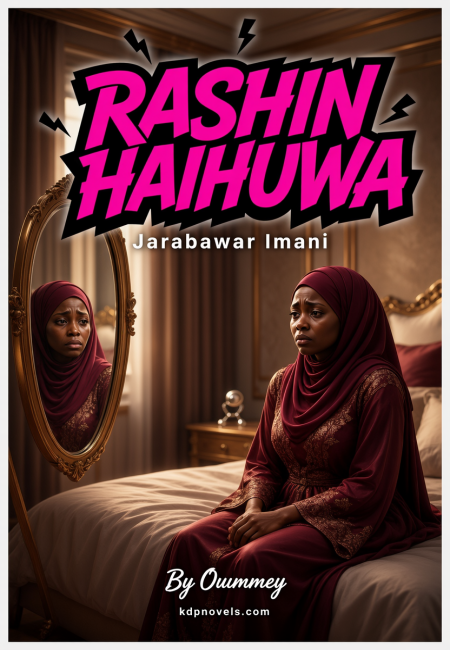
What happens when a woman is judged not by the kindness in her heart, the love she gives, or the sacrifices she makes, but by the child she has not been able to conceive?
For Khadijah, marriage was once a place of affection, companionship, and hope. But as the years pass without the sound of a child in her home, that hope slowly becomes a source of pain. Her husband, Salees, has children from another woman, and every innocent cry, every family gathering, and every reminder of motherhood becomes another wound she is forced to hide.
When jealousy, emotional neglect, accusations, and cruel words begin to surround her, Khadijah finds herself fighting a battle that nobody seems willing to understand. Her greatest struggle is not simply the absence of a child. It is the way society, family, and even the people closest to her begin to measure her worth through motherhood.
RASHIN HAIHUWA: Ƙaddarar Wasu Matan is a deeply emotional story about infertility, marriage, co-wife rivalry, patience, faith, family pressure, and the quiet suffering of women whose greatest pain is often invisible to everyone around them.
Summary
Khadijah appears to have many of the things a woman could wish for. She is beautiful, well presented, educated, employed, and married. Yet beneath that outward confidence lies a private pain that has gradually consumed her happiness. She desperately wants to become a mother, but despite the passing years, pregnancy remains beyond her reach. What makes the situation more painful is that her husband, Salees, already has children through his other wife, Mariya. Every time Khadijah encounters those children, she is reminded of the one thing she wishes she could have for herself.
Her relationship with Salees is also changing. The man she once experienced as a loving husband increasingly becomes someone whose words and actions leave her feeling unwanted and misunderstood. Even ordinary disagreements can quickly turn into painful reminders of her infertility. Rather than receiving the emotional reassurance she needs, Khadijah often finds herself defending her worth and trying to prove that she is more than the absence of a child in her life.
Mariya, meanwhile, becomes an important source of tension in the household. Although she sometimes presents herself as calm and reasonable, Khadijah believes there is another side to her behavior. Their rivalry becomes particularly complicated because Mariya has children, giving her a position of emotional security that Khadijah desperately wishes she possessed. Her daughter, Ilham, also becomes involved in the conflict, creating situations that push Khadijah closer to the edge of her patience. Hurtful comments and deliberate provocations gradually transform the home into a place where Khadijah struggles to feel safe emotionally.
Yet Khadijah is not portrayed simply as a victim without flaws. Her own frustration sometimes causes her to react in ways she later has to confront. Her treatment of Ilham, particularly when anger overwhelms her, reveals how prolonged emotional pain can affect a person's judgment. The story therefore goes beyond asking readers to sympathize with Khadijah. It also challenges them to consider the consequences of pain that is allowed to grow unchecked.
Through her relationship with her mother, Ummi, another side of Khadijah emerges. Ummi reminds her that infertility should not be interpreted as divine rejection or personal failure. She encourages her daughter to remain patient, protect her character, and avoid allowing jealousy to destroy her relationship with her husband's children or his other wife. These conversations introduce one of the novel's central ideas: sometimes the hardest form of strength is remaining decent when circumstances give you every reason to become bitter.
Genre
RASHIN HAIHUWA belongs primarily to the genre of Hausa contemporary romance and domestic drama, with strong elements of family conflict, emotional fiction, social commentary, marriage drama, and Islamic values.
Rather than depending solely on romance, the story uses marriage and family relationships as a way of exploring a much larger social issue. Infertility becomes the center through which questions about womanhood, dignity, jealousy, co-wife relationships, motherhood, emotional abuse, patience, and faith are examined.
Setting
The story is largely situated within the intimate world of marriage and family life. Much of the emotional conflict takes place inside Khadijah and Salees's home, where ordinary spaces such as the bedroom, sitting room, kitchen, and family areas become settings for conversations, confrontations, misunderstandings, and moments of loneliness.
The workplace provides a contrast to the domestic environment. Khadijah works within a revenue or tax-related government institution, where she has professional responsibilities and ambitions of her own. Her career and the possibility of promotion show that her identity extends beyond being a wife.
The wider family environment is equally important. Visits, phone calls with her mother and sister, interactions with Mariya and the children, and encounters with Salees's relatives demonstrate how infertility can become a matter that affects an entire family rather than remaining a private issue between husband and wife.
Core Themes
Infertility and the Value of a Woman
The central theme of the novel is infertility and the damaging belief that a woman who cannot conceive is somehow incomplete. Khadijah's suffering illustrates how easily society can reduce a woman's identity to motherhood.
The novel strongly challenges that mindset by presenting Khadijah as a woman with intelligence, beauty, employment, emotions, responsibilities, and the ability to love. Her inability to have a child does not erase those qualities.
Marriage Under Pressure
The marriage between Khadijah and Salees demonstrates how unresolved pain can gradually change a relationship. Love may still exist, but communication, compassion, trust, and emotional security can weaken when both partners stop understanding one another.
The story raises an uncomfortable question: can a marriage remain emotionally healthy when one partner's greatest vulnerability repeatedly becomes a weapon during disagreements?
Co-Wife Rivalry
Mariya's presence introduces another major source of tension. The relationship between the two women shows how polygamous marriage can become complicated when affection, children, insecurity, and competition overlap.
The novel does not present rivalry as something simple. It explores how insecurity can develop when one woman possesses something another desperately desires.
The Psychological Cost of Cruel Words
Some of the most damaging moments in the story are not physical confrontations but words. A single statement about Khadijah's infertility can undo whatever emotional strength she has managed to build.
The novel demonstrates how repeated humiliation can affect a person's confidence, judgment, relationships, and emotional stability.
Faith, Patience, and Divine Decree
Religion plays an important role in Khadijah's understanding of her situation. Her mother repeatedly encourages her to maintain tawakkul and remember that not receiving something immediately does not mean Allah has abandoned her.
The story therefore treats infertility not only as a social problem but also as a test of patience, faith, character, and acceptance of divine decree.
Motherhood Beyond Biology
Another important idea is that motherhood and compassion should not be reduced to biological reproduction. Khadijah's complicated feelings toward Ilham and Amir demonstrate the painful contradiction between loving children and being reminded that she does not have a child of her own.
The novel asks readers to look deeper into that emotional conflict rather than judging a woman solely by her reactions.
Key Characters
Khadijah
Khadijah is the emotional center of the story. She is a married woman whose inability to conceive has gradually become the defining judgment placed upon her by people around her.
She is intelligent, professionally active, conscious of her appearance, affectionate toward her husband, and deeply attached to the dream of becoming a mother. At the same time, years of emotional pressure have made her vulnerable to anger, jealousy, frustration, and despair.
Her character is particularly compelling because she is not perfect. She makes mistakes, loses her temper, and sometimes responds to cruelty with cruelty. That imperfection makes her struggle feel human rather than idealized.
Salees
Salees is Khadijah's husband and one of the most complicated figures in her life. He appears to love his children deeply, but his failure to consistently recognize Khadijah's emotional wounds creates serious problems in their marriage.
His relationship with Khadijah becomes increasingly strained because he sometimes responds to conflict with anger instead of empathy. His actions force readers to consider the responsibilities of a husband toward a wife experiencing a deeply sensitive struggle.
Mariya
Mariya is Salees's other wife and the mother of his children. Her position within the family gives her a sense of security that Khadijah does not have.
Her relationship with Khadijah is filled with tension, subtle competition, and emotional manipulation. Whether every action she takes is deliberately malicious or partly influenced by her own insecurities, she becomes one of the greatest sources of pressure in Khadijah's life.
Ilham
Ilham is Salees and Mariya's daughter. Although she is still young, her relationship with Khadijah becomes increasingly hostile. Her words and behavior expose how adult conflicts can affect children and how children can sometimes repeat attitudes they have learned from the adults around them.
Her character also contributes to the novel's exploration of stepfamily relationships and the difficulties that arise when affection, discipline, jealousy, and family loyalty collide.
Amir
Amir is Mariya's young child and another reminder of Khadijah's longing for motherhood. His presence in the household triggers some of the most painful emotional moments for Khadijah, particularly when his needs interrupt her private moments with Salees.
Importantly, Amir himself is innocent of the conflict surrounding him. His character highlights how children can become caught in adult emotional battles without understanding the reasons behind them.
Ummi
Ummi represents wisdom, emotional support, and maternal compassion. Through her conversations with Khadijah, she provides a different perspective on infertility and marriage.
She does not simply encourage her daughter to endure suffering. She also reminds her to maintain good character, avoid harming Mariya or her children, and place her trust in Allah.
Analytics and Insight
The strongest feature of RASHIN HAIHUWA is its emotional subject matter. Infertility is often discussed as a medical or biological issue, but this story focuses heavily on its social and psychological consequences. That approach gives the narrative room to explore the things that cannot be measured through medical tests: humiliation, insecurity, loneliness, comparison, fear of abandonment, and the desperate desire to feel valued.
Khadijah's greatest enemy is arguably not infertility itself. It is the meaning other people attach to it. When a woman repeatedly hears that she is incomplete because she has no child, the words can eventually become part of the way she sees herself. This is one of the novel's most significant psychological insights.
The story also presents an interesting contrast between Khadijah's professional identity and her domestic identity. At work, she has responsibilities, status, skills, and the possibility of promotion. At home, however, all those achievements can suddenly appear insignificant when the subject turns to motherhood. This contrast reinforces the question of whether a woman's achievements should ever be measured against her ability to give birth.
Another important insight is the danger of unresolved emotional wounds. Khadijah begins with understandable pain, but as the pressure continues, her reactions become increasingly severe. Her treatment of Ilham shows that being wounded does not automatically make every reaction justified. The story therefore allows readers to sympathize with Khadijah while still questioning some of her decisions.
The novel also emphasizes the importance of communication within marriage. Salees often sees Khadijah's behavior without fully understanding the pain behind it, while Khadijah carries so much resentment that honest communication becomes increasingly difficult. Their relationship demonstrates how two people can remain connected by love while becoming emotionally distant because neither properly addresses the wound between them.
The Emotional Conflict at the Heart of the Story
At the center of the novel is a painful contradiction. Khadijah wants to be loved as a wife, but she also desperately wants to become a mother. She wants to accept Allah's decree, yet she struggles whenever circumstances remind her of what she lacks. She wants peace with Mariya, yet Mariya's presence constantly reminds her of her own situation. She wants to love Salees's children, yet their existence sometimes touches the deepest wound in her heart.
That contradiction makes her journey emotionally powerful.
The reader is not simply asked to decide who is right or wrong. Instead, the story encourages readers to understand how pain can affect people differently and how a family can become trapped in a cycle of resentment when compassion disappears.
A Quote From the Novel
“Ba wai tawayar halitta ba, bana hali ba face na wani arziki da Allah ke bawa bayin sa da yaso ba.”
The thought behind this passage captures one of the novel's central messages: not receiving the blessing of children should never automatically be interpreted as proof that a person is worthless, rejected, or forgotten by Allah.
What Readers Can Expect
Readers should expect an emotionally intense domestic story filled with marriage problems, family tension, co-wife rivalry, jealousy, painful misunderstandings, religious reflection, and moments that challenge the idea of what makes a woman valuable.
The novel is particularly suited to readers who enjoy Hausa fiction that does more than tell a love story. It tackles a real and sensitive social issue and places its characters in situations where every decision carries emotional consequences.
Most importantly, RASHIN HAIHUWA: Ƙaddarar Wasu Matan invites readers to look beyond the surface of infertility. Behind every woman who has not conceived may be a story of prayers, tears, unanswered questions, family pressure, and private battles that nobody sees.
Final Insight
At its heart, this is a story about dignity.
It asks readers to reconsider the way society speaks to women who have not had children. It asks husbands to recognize that emotional wounds cannot be healed with criticism. It asks families to understand that careless words can leave scars. And it reminds women facing difficult circumstances that their worth cannot be reduced to one unanswered prayer.
Khadijah's journey is ultimately not only about whether she will become a mother. It is about whether she can survive the pressure surrounding her without losing herself in the process.
RASHIN HAIHUWA: Ƙaddarar Wasu Matan is therefore a story of pain, patience, family conflict, faith, and the search for dignity in a world that too often judges women by what they have been unable to receive.





![<? $row['name']; ?>](https://kdpnovels.com/Public/thumb/225x325/ebook/2026/04/kdp-velvet-76-rayuwa-da-gi-i-0187303be8.webp)
![<? $row['name']; ?>](https://kdpnovels.com/Public/thumb/225x325/ebook/2026/04/kdp-velvet-78-karuwan-cikin-gida-book-2-4162a6ec19.webp)
![<? $row['name']; ?>](https://kdpnovels.com/Public/thumb/225x325/ebook/2026/04/kdp-velvet-79-ar-goggo-b3f15a0ce3.webp)
![<? $row['name']; ?>](https://kdpnovels.com/Public/thumb/225x325/ebook/2026/04/kdp-velvet-82-rayuwar-mace-e1d7de2487.webp)
![<? $row['name']; ?>](https://kdpnovels.com/Public/thumb/225x325/ebook/2026/04/kdp-velvet-83-rana-daya-book-1-beba7251c1.webp)
![<? $row['name']; ?>](https://kdpnovels.com/Public/thumb/225x325/ebook/2026/04/kdp-velvet-91-kida-a-ruwa-3-472106cedd.webp)
![<? $row['name']; ?>](https://kdpnovels.com/Public/thumb/225x325/ebook/2026/04/kdp-velvet-93-rainon-soja-book-1-286bef18e2.webp)
![<? $row['name']; ?>](https://kdpnovels.com/Public/thumb/225x325/ebook/2026/04/kdp-velvet-95-abunda-ke-boye-4c21700ec8.webp)
![<? $row['name']; ?>](https://kdpnovels.com/Public/thumb/225x325/ebook/2026/04/kdp-velvet-96-ranar-naka-complt-1a5ed3d476.webp)
![<? $row['name']; ?>](https://kdpnovels.com/Public/thumb/225x325/ebook/2026/04/kdp-velvet-97-cutarwa-complt-d352334231.webp)
![<? $row['name']; ?>](https://kdpnovels.com/Public/thumb/225x325/ebook/2026/04/kdp-velvet-98-babu-so-619172ab35.webp)
![<? $row['name']; ?>](https://kdpnovels.com/Public/thumb/225x325/ebook/2026/04/kdp-velvet-99-rayuwa-da-gi-i-076b92a60b.webp)
RASHIN HAIHUWA: Ƙaddarar Wasu Matan
Hook
What happens when a woman is judged not by the kindness in her heart, the love she gives, or the sacrifices she makes, but by the child she has not been able to conceive?
For Khadijah, marriage was once a place of affection, companionship, and hope. But as the years pass without the sound of a child in her home, that hope slowly becomes a source of pain. Her husband, Salees, has children from another woman, and every innocent cry, every family gathering, and every reminder of motherhood becomes another wound she is forced to hide.
When jealousy, emotional neglect, accusations, and cruel words begin to surround her, Khadijah finds herself fighting a battle that nobody seems willing to understand. Her greatest struggle is not simply the absence of a child. It is the way society, family, and even the people closest to her begin to measure her worth through motherhood.
RASHIN HAIHUWA: Ƙaddarar Wasu Matan is a deeply emotional story about infertility, marriage, co-wife rivalry, patience, faith, family pressure, and the quiet suffering of women whose greatest pain is often invisible to everyone around them.
Summary
Khadijah appears to have many of the things a woman could wish for. She is beautiful, well presented, educated, employed, and married. Yet beneath that outward confidence lies a private pain that has gradually consumed her happiness. She desperately wants to become a mother, but despite the passing years, pregnancy remains beyond her reach. What makes the situation more painful is that her husband, Salees, already has children through his other wife, Mariya. Every time Khadijah encounters those children, she is reminded of the one thing she wishes she could have for herself.
Her relationship with Salees is also changing. The man she once experienced as a loving husband increasingly becomes someone whose words and actions leave her feeling unwanted and misunderstood. Even ordinary disagreements can quickly turn into painful reminders of her infertility. Rather than receiving the emotional reassurance she needs, Khadijah often finds herself defending her worth and trying to prove that she is more than the absence of a child in her life.
Mariya, meanwhile, becomes an important source of tension in the household. Although she sometimes presents herself as calm and reasonable, Khadijah believes there is another side to her behavior. Their rivalry becomes particularly complicated because Mariya has children, giving her a position of emotional security that Khadijah desperately wishes she possessed. Her daughter, Ilham, also becomes involved in the conflict, creating situations that push Khadijah closer to the edge of her patience. Hurtful comments and deliberate provocations gradually transform the home into a place where Khadijah struggles to feel safe emotionally.
Yet Khadijah is not portrayed simply as a victim without flaws. Her own frustration sometimes causes her to react in ways she later has to confront. Her treatment of Ilham, particularly when anger overwhelms her, reveals how prolonged emotional pain can affect a person's judgment. The story therefore goes beyond asking readers to sympathize with Khadijah. It also challenges them to consider the consequences of pain that is allowed to grow unchecked.
Through her relationship with her mother, Ummi, another side of Khadijah emerges. Ummi reminds her that infertility should not be interpreted as divine rejection or personal failure. She encourages her daughter to remain patient, protect her character, and avoid allowing jealousy to destroy her relationship with her husband's children or his other wife. These conversations introduce one of the novel's central ideas: sometimes the hardest form of strength is remaining decent when circumstances give you every reason to become bitter.
Genre
RASHIN HAIHUWA belongs primarily to the genre of Hausa contemporary romance and domestic drama, with strong elements of family conflict, emotional fiction, social commentary, marriage drama, and Islamic values.
Rather than depending solely on romance, the story uses marriage and family relationships as a way of exploring a much larger social issue. Infertility becomes the center through which questions about womanhood, dignity, jealousy, co-wife relationships, motherhood, emotional abuse, patience, and faith are examined.
Setting
The story is largely situated within the intimate world of marriage and family life. Much of the emotional conflict takes place inside Khadijah and Salees's home, where ordinary spaces such as the bedroom, sitting room, kitchen, and family areas become settings for conversations, confrontations, misunderstandings, and moments of loneliness.
The workplace provides a contrast to the domestic environment. Khadijah works within a revenue or tax-related government institution, where she has professional responsibilities and ambitions of her own. Her career and the possibility of promotion show that her identity extends beyond being a wife.
The wider family environment is equally important. Visits, phone calls with her mother and sister, interactions with Mariya and the children, and encounters with Salees's relatives demonstrate how infertility can become a matter that affects an entire family rather than remaining a private issue between husband and wife.
Core Themes
Infertility and the Value of a Woman
The central theme of the novel is infertility and the damaging belief that a woman who cannot conceive is somehow incomplete. Khadijah's suffering illustrates how easily society can reduce a woman's identity to motherhood.
The novel strongly challenges that mindset by presenting Khadijah as a woman with intelligence, beauty, employment, emotions, responsibilities, and the ability to love. Her inability to have a child does not erase those qualities.
Marriage Under Pressure
The marriage between Khadijah and Salees demonstrates how unresolved pain can gradually change a relationship. Love may still exist, but communication, compassion, trust, and emotional security can weaken when both partners stop understanding one another.
The story raises an uncomfortable question: can a marriage remain emotionally healthy when one partner's greatest vulnerability repeatedly becomes a weapon during disagreements?
Co-Wife Rivalry
Mariya's presence introduces another major source of tension. The relationship between the two women shows how polygamous marriage can become complicated when affection, children, insecurity, and competition overlap.
The novel does not present rivalry as something simple. It explores how insecurity can develop when one woman possesses something another desperately desires.
The Psychological Cost of Cruel Words
Some of the most damaging moments in the story are not physical confrontations but words. A single statement about Khadijah's infertility can undo whatever emotional strength she has managed to build.
The novel demonstrates how repeated humiliation can affect a person's confidence, judgment, relationships, and emotional stability.
Faith, Patience, and Divine Decree
Religion plays an important role in Khadijah's understanding of her situation. Her mother repeatedly encourages her to maintain tawakkul and remember that not receiving something immediately does not mean Allah has abandoned her.
The story therefore treats infertility not only as a social problem but also as a test of patience, faith, character, and acceptance of divine decree.
Motherhood Beyond Biology
Another important idea is that motherhood and compassion should not be reduced to biological reproduction. Khadijah's complicated feelings toward Ilham and Amir demonstrate the painful contradiction between loving children and being reminded that she does not have a child of her own.
The novel asks readers to look deeper into that emotional conflict rather than judging a woman solely by her reactions.
Key Characters
Khadijah
Khadijah is the emotional center of the story. She is a married woman whose inability to conceive has gradually become the defining judgment placed upon her by people around her.
She is intelligent, professionally active, conscious of her appearance, affectionate toward her husband, and deeply attached to the dream of becoming a mother. At the same time, years of emotional pressure have made her vulnerable to anger, jealousy, frustration, and despair.
Her character is particularly compelling because she is not perfect. She makes mistakes, loses her temper, and sometimes responds to cruelty with cruelty. That imperfection makes her struggle feel human rather than idealized.
Salees
Salees is Khadijah's husband and one of the most complicated figures in her life. He appears to love his children deeply, but his failure to consistently recognize Khadijah's emotional wounds creates serious problems in their marriage.
His relationship with Khadijah becomes increasingly strained because he sometimes responds to conflict with anger instead of empathy. His actions force readers to consider the responsibilities of a husband toward a wife experiencing a deeply sensitive struggle.
Mariya
Mariya is Salees's other wife and the mother of his children. Her position within the family gives her a sense of security that Khadijah does not have.
Her relationship with Khadijah is filled with tension, subtle competition, and emotional manipulation. Whether every action she takes is deliberately malicious or partly influenced by her own insecurities, she becomes one of the greatest sources of pressure in Khadijah's life.
Ilham
Ilham is Salees and Mariya's daughter. Although she is still young, her relationship with Khadijah becomes increasingly hostile. Her words and behavior expose how adult conflicts can affect children and how children can sometimes repeat attitudes they have learned from the adults around them.
Her character also contributes to the novel's exploration of stepfamily relationships and the difficulties that arise when affection, discipline, jealousy, and family loyalty collide.
Amir
Amir is Mariya's young child and another reminder of Khadijah's longing for motherhood. His presence in the household triggers some of the most painful emotional moments for Khadijah, particularly when his needs interrupt her private moments with Salees.
Importantly, Amir himself is innocent of the conflict surrounding him. His character highlights how children can become caught in adult emotional battles without understanding the reasons behind them.
Ummi
Ummi represents wisdom, emotional support, and maternal compassion. Through her conversations with Khadijah, she provides a different perspective on infertility and marriage.
She does not simply encourage her daughter to endure suffering. She also reminds her to maintain good character, avoid harming Mariya or her children, and place her trust in Allah.
Analytics and Insight
The strongest feature of RASHIN HAIHUWA is its emotional subject matter. Infertility is often discussed as a medical or biological issue, but this story focuses heavily on its social and psychological consequences. That approach gives the narrative room to explore the things that cannot be measured through medical tests: humiliation, insecurity, loneliness, comparison, fear of abandonment, and the desperate desire to feel valued.
Khadijah's greatest enemy is arguably not infertility itself. It is the meaning other people attach to it. When a woman repeatedly hears that she is incomplete because she has no child, the words can eventually become part of the way she sees herself. This is one of the novel's most significant psychological insights.
The story also presents an interesting contrast between Khadijah's professional identity and her domestic identity. At work, she has responsibilities, status, skills, and the possibility of promotion. At home, however, all those achievements can suddenly appear insignificant when the subject turns to motherhood. This contrast reinforces the question of whether a woman's achievements should ever be measured against her ability to give birth.
Another important insight is the danger of unresolved emotional wounds. Khadijah begins with understandable pain, but as the pressure continues, her reactions become increasingly severe. Her treatment of Ilham shows that being wounded does not automatically make every reaction justified. The story therefore allows readers to sympathize with Khadijah while still questioning some of her decisions.
The novel also emphasizes the importance of communication within marriage. Salees often sees Khadijah's behavior without fully understanding the pain behind it, while Khadijah carries so much resentment that honest communication becomes increasingly difficult. Their relationship demonstrates how two people can remain connected by love while becoming emotionally distant because neither properly addresses the wound between them.
The Emotional Conflict at the Heart of the Story
At the center of the novel is a painful contradiction. Khadijah wants to be loved as a wife, but she also desperately wants to become a mother. She wants to accept Allah's decree, yet she struggles whenever circumstances remind her of what she lacks. She wants peace with Mariya, yet Mariya's presence constantly reminds her of her own situation. She wants to love Salees's children, yet their existence sometimes touches the deepest wound in her heart.
That contradiction makes her journey emotionally powerful.
The reader is not simply asked to decide who is right or wrong. Instead, the story encourages readers to understand how pain can affect people differently and how a family can become trapped in a cycle of resentment when compassion disappears.
A Quote From the Novel
The thought behind this passage captures one of the novel's central messages: not receiving the blessing of children should never automatically be interpreted as proof that a person is worthless, rejected, or forgotten by Allah.
What Readers Can Expect
Readers should expect an emotionally intense domestic story filled with marriage problems, family tension, co-wife rivalry, jealousy, painful misunderstandings, religious reflection, and moments that challenge the idea of what makes a woman valuable.
The novel is particularly suited to readers who enjoy Hausa fiction that does more than tell a love story. It tackles a real and sensitive social issue and places its characters in situations where every decision carries emotional consequences.
Most importantly, RASHIN HAIHUWA: Ƙaddarar Wasu Matan invites readers to look beyond the surface of infertility. Behind every woman who has not conceived may be a story of prayers, tears, unanswered questions, family pressure, and private battles that nobody sees.
Final Insight
At its heart, this is a story about dignity.
It asks readers to reconsider the way society speaks to women who have not had children. It asks husbands to recognize that emotional wounds cannot be healed with criticism. It asks families to understand that careless words can leave scars. And it reminds women facing difficult circumstances that their worth cannot be reduced to one unanswered prayer.
Khadijah's journey is ultimately not only about whether she will become a mother. It is about whether she can survive the pressure surrounding her without losing herself in the process.
RASHIN HAIHUWA: Ƙaddarar Wasu Matan is therefore a story of pain, patience, family conflict, faith, and the search for dignity in a world that too often judges women by what they have been unable to receive.